if the charge on an isolated spherical conductor is doubled, what happens to its capacitance?
Electrostatic Potential and Capacitance Class 12 | Chapter 2 | Physics | CBSE |
Electrostatic Potential and Capacitance
(I) Electrostatic Potential
Electrostatic potential free energy is the amount of work done in bringing a accuse from one betoken to the electrical field against the electric field without alter in kinetic energy.
Note that piece of work done by an electric field in moving a given test charge from one point to some other depends only on the initial and final points position . Information technology does not depend on the path called in going from one betoken to another. Thus; electrostatic potential energy is conservative in nature.
Westward external = -q ten 1 two∫East.dl = q ten ΔV
Dimensional formula for electrostatic potential departure is
ΔV = WAB / q = [M L2 T-3 A-1]
SI unit of measurement of electrostatic potential deviation is 1 volt. That is why potential difference is sometimes referred as voltage: 1 V = 1 J / 1 C = one NmC-one
Electrostatic potential divergence betwixt any two points in an electrostatic field is said to be 1 volt, when one joule of work is done in moving a positive accuse of one coulomb from one point to some other confronting the electrostatic force of field without any dispatch.
Electrostatic potential at any point in a region of electrostatic field is the minimum work done in conveying a unit positive accuse from infinity to that bespeak. VB = W∞B / q
Conservative Nature of Electrostatic Potential
A physical quantity which depends on initial and final positions only or does not depend on path followed by it is said to be conservative in nature.
Let a accuse qo moves from A to B through path ane and Q to P through path two
WestAB = qo (FiveB-5A) …..(i)
When examination charge is taken from A to B
WBA = qo (VA-VB) ……(two)
Calculation equation (i) and (ii); we go
Due westAB + WBA = qo (5B-5A+ VA-FiveB)
WestAB + WestBA = 0
Thus, Electric potential is conservative in nature.
Electrostatic Potential due to a Bespeak Charge
Suppose we have to calculate electric potential at any point P due to unmarried point charge +q at O; where OP = r
Past definition, electrostatic potential at P is that the amount of work done in carrying a unit positive accuse from ∞ to P.
Equally piece of work done does not depend on the path, we have to opt a expedient path along the radial direction from infinity to point P without acceleration.
At some intermediate A on this path where OA = x, the electrostatic force on the unit of measurement accuse is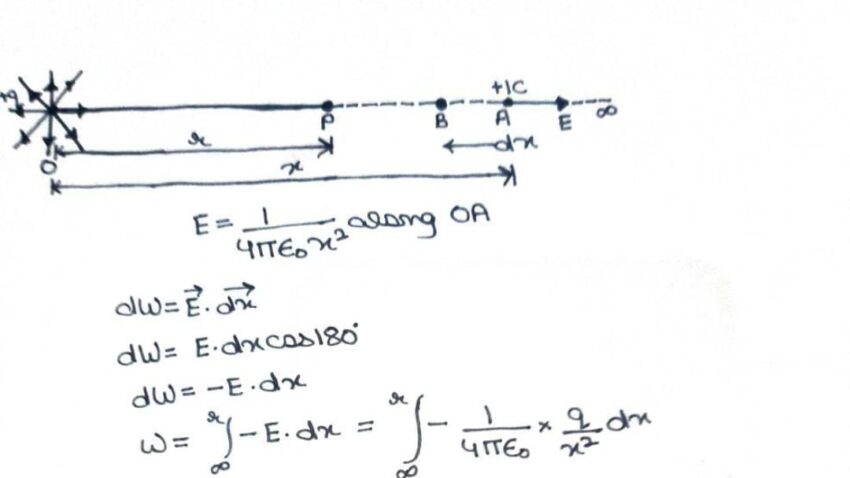
 Variation of Electric Potential and Electric Intensity with distance is as follows: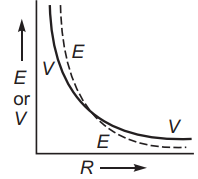
Equipotential Surfaces
An equipotential surface is that surface at every point of which same electric potential is nowadays.
Nosotros know, potential departure betwixt 2 points B and A = Work washed in conveying unit positive test charge from A to B, i.e., VB – VA = WestAB
If points A and B lie on equipotential surfaces, so VB = VA
∴ WAB= FiveB - 5A = 0 Of import Properties of Equipotential Surfaces
- Work is done in moving a test charge from one point to another point on an equipotential surface is zero
- Electrical field is always tangential to the equipotential surface
- Two equipotential surfaces tin never cross or overlap each other.
- Equipotential surfaces are closer in the regions of potent electric field and they are farther autonomously in the region of weak electric fields.
Pattern of Equipotential Surface
Equipotential Surfaces due to betoken accuse

Equipotential Surface due to 2 an electric dipole

Equipotential Surface due to uniform electric field

Equipotential Surface due to an Two positive charges

Question : Why are electric Field lines perpendicular at some extent on an equipotential surface of usher?
Answer: Electric field lines are perpendicular at a point on an equipotential surface considering if they are not perpendicular then there volition be a non zero component of electric field along the equipotential surface which causes the piece of work to be done which is non possible.
Question : What is the corporeality of piece of work washed in moving a point charge effectually a circular arc of radius r at the centre of which another point accuse is located.
Answer: The corporeality of work done in carrying a charge on an equipotential surface is always zero.
Principle of Superposition of Potentials
Let qane, q2 …….qn exist due north positive charges placed at r1, rii …rn from signal A

Potential at A due to q1 (V1) = kqane / r1
Potential at A due to q2 (V2) = kq2 / r2
.
.
Potential at A due to qn (Vnorth) = kqn / rn
Total potential at A due to n charges (V) = Five1 + V2 + 53 + …….. Fiven

Related
|
|
|
|
|
|
|
|
|
|
|
|
|
|
|
|
|
|
Relation Between Electric Field and Electric Potential
Let; a charge + Q is placed at point O. A examination charge qo is placed at point A
Permit A and B exist two points separated by distance dr. The two points A and B are so shut that field betwixt them remains almost constant.
The external force required to motility the examination charge qo (without acceleration) confronting the electric field E is given by
F = -qo East
Work done to move the exam accuse from A to B is
Due west = F . dr = – qo E. dr … (i)
Also work washed in moving test accuse from A to B is
W = Charge ten potential departure = qo (VB – VA) = qo . dv ….(ii)
Equation equations (i) and (2) ;
-qo Due east. dr = qo . dv
East = -dv / dr
The quantity dV /dr is the rate of variation of potential with distance and is called potential gradient. Thus the electric field at any point is adequate to the negative of potential gradient at that time. The negative sign indicates that the direction of electric field is in the direction of diminishing potential. Moreover the field is in the direction where this pass up is steepest.
Question: A test charge Q is moved without dispatch from A to C along the path from A to B and and so from B to C in electrical field Due east every bit shown in the effigy.
(i) Calculate the potential difference between A and C
(ii) At which signal the electrical potential is more than and why?

Solution: (i) electric field intensity and potential energy are related every bit
E = -dV / dr
dV = -E .dr
Vc -VA = -4 E
(ii) As VC – VA = -4E is negative
VC < VA
Potential is greater at indicate A than point C, as potential decreases along the direction of electric field.
Question: Why do equipotential surface get close to each other nigh the point charge?
Answer: Equipotential surfaces get close to each other nearly the point charges as potent electric field is produced there.
E = -dV / dr
For a given equipotential surface small dr correspond potent electric field and vice versa.
Question: Why the potential within a hollow spherical charged conductor is constant and has the aforementioned value as on its surface?
Solution: Electrical field inside the hollow spherical charged usher is zero. So, no work is done in moving a charge inside the vanquish. Thus, potential is constant and therefore, equal to its value at the surface, i.e., V = 1 / 4π εo . q / r
Electric Potential Energy for two Charge Particles in Absence of External Electric Field
Suppose a point charge qone is at rest at a bespeak Pi in space. It takes no work to bring the first accuse qone since there is no field yet to work against.

∴ Westwardi = 0
Electric potential due to charge q1 at signal Ptwo at distance r12 from P1 will be
 If accuse q2 is moved in from infinity to point Pii, the work required is
W2 = potential x test accuse
 Equally the work done is stored every bit the potential free energy U of the system, (q1 + q2) and then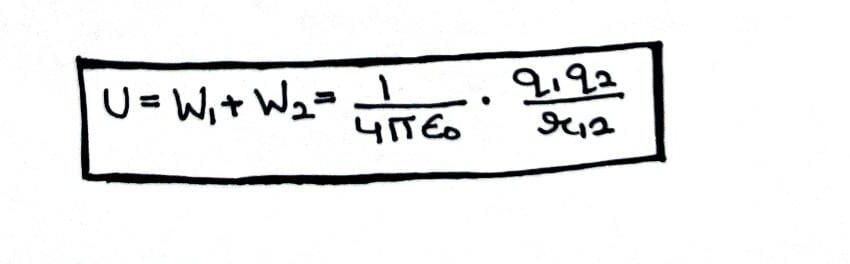
Electric Potential Energy for 2 Charge Particles in Absence of External Electrical Field
Now we bring in the charge q3 from infinity to the point P3. Work has to be done against the forces exerted past q1 and qii.
Therefore; W3 = potential at Piii due to q1 and q2

Hence electrostatic potential energy of the arrangement qi + qtwo + q3 is
U = Full work washed to assemble the three charges = Wi + Wtwo + W3

Potential Free energy for a Unmarried Charge in an External Field
We accept to determine the potential free energy of a accuse q in an external field E at a signal P where the corresponding external potential is V.
We know; V at a betoken P is the corporeality of work done in bringing a unit positive charge from infinity to the point P.
Thus the work washed in bringing a charge Q from infinity to the bespeak P will exist qV , i.e., W = qV
The work done is stored as a potential energy of the charge q. If r is the position vector of point P relative to some origin, so
Potential free energy of a single charge q at r in external field = q. Five r
Potential Energy for a System of Two Point Charges in an External Field
Let V ri and V r2 the electric potentials of the field Due east at the points having vectors r1 and rtwo
Piece of work done in bringing q1 from ∞ to r1 against the electric field = qone Five r1
Work done in bringing q2 from ∞ to r2 confronting the electric field = q2 V r2
Piece of work done on qtwo against the force exerted by q1 = ane / 4πεo . qane q2 / r12
where r12 is the distance betwixt qane and qtwo
Total potential energy of the arrangement = The work done in assembling the ii charges
U = qi 5 r1 + qii V r2 + ane / 4πεo . q1 qtwo / r12
Electric Potential due to Charged Ring
Let q exist total charge distributed over a ring of radius R
dl be small element length
dq be charge on portion dl

Variation of Electrical Potential (V) with distance (x) for a ring

Special Cases
1)If x >>> R ; R2 is neglected
V = Kq / x2; Ring behaves as point charge
2) At centre of ring
10 = 0
V = kq / R Electric Potential due to Uniformly Charged Spherical Shell
Potential at a point outside the shell ( r > R )
E = Kq / r2
E = -dV / dr
dV = -Eastward.dr
dV = Kq / rii .dr
Integrating both sides
∫dV = Kq ∫ 1 / rtwo .dr
Five = Kq / r
Potential at the surface of shell ( r = R)
V = Kq / R
Potential within the vanquish
We know; inside the beat out E = 0 and dV = -E . dr
dV = 0, i.due east., V is constant within the beat out

Electric Potential at whatever betoken due to an Electric Dipole
Let an electric dipole consisting of two equal and unlike point charges -q at A and +q at B, separated past a small altitude AB = 2a, with heart at O. The dipole moment P = q ten 2a
Permit us take the origin at the centre of dipole. We have to calculate electric potential at whatsoever betoken P where OP = r. Let the distance of point P from charge -q at A be ri, i.e., AP = r1 and distance of point P from charge + q at B be rii, i.e., BP = r2
Electrostatic potential at P due to -q charge at A: VA = -kq / r1
Electrostatic potential at P due to -q charge at B: VB = kq / rtwo
FiveP = VA + VB = -kq / rone+ kq / rii
Construction : AN perpendicular CN , BM perpendicular CN
In Δ AON ; Cos θ = ON / OA = ON / a
a Cos θ = ON
Similarily; OM = a Cos θ
r1 = AP ≈ NP = CO + ON = r + a Cos θ
r2 = BP ≈ MP = CO – OM = r – a Cos θ
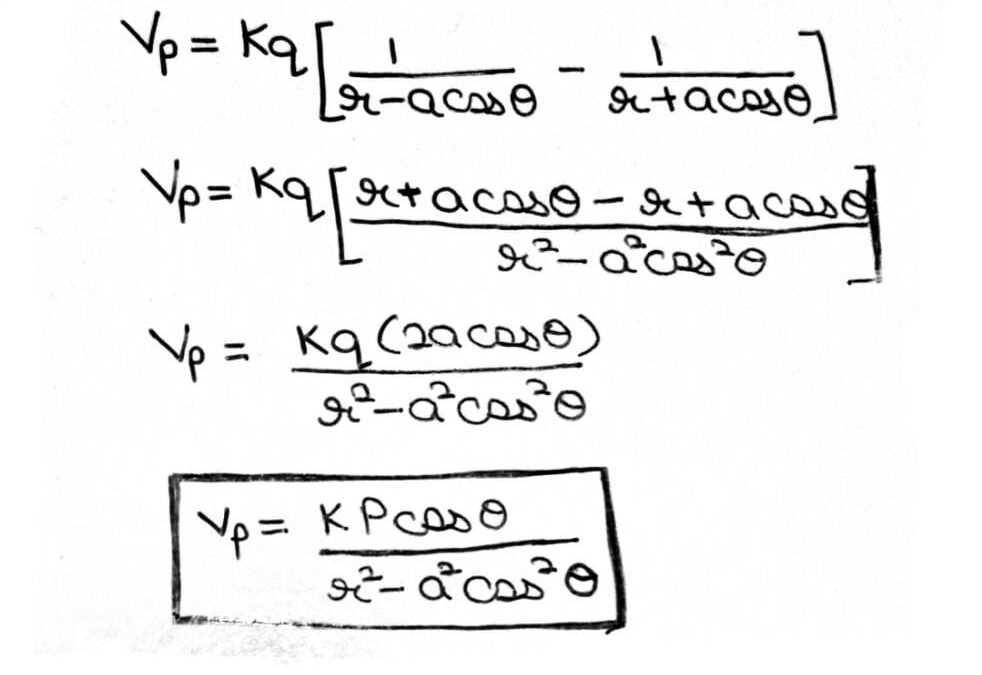
Special Cases
one)For short dipole; if r>>>a then a2 is neglected

2) On axial Line; θ = 0° [ cos 0° = 1 ]
V axial = KP / r2
three) On equatorial line; θ = xc° [ cos 90° = 1]
V equatorial = 0
Thus, potential at a point on equatorial line is zippo
Question : A bird perches on a naked high ability line and nothing happens to the bird. The same line is touched by a man standing on the ground and he gets deadly shocked?
Answer: The whole trunk of bird is at constant potential. Accuse does not flow and no stupor is produced. The human touching the ground maintains a potential difference among the different parts of his body. A large electric current flows which electrolysis blood and requite rise to death.
Question : Iii charges -q, +Q and -q are placed at constant distances on a straight line. If the potential free energy of the three charge organisation is zero. Notice the ratio Q / q
Respond: Every bit the Cyberspace potential energy of this system is nix
ane / 4πεo [ -q Q / r + (-q) (-q) / 2r + Q (-q) / r ] = 0
-Q + q / two – Q = 0
2 Q = q / 2
Q / q = 1 / iv = 1 : 4
Electrostatic Shielding
The phenomenon of creating a region gratuitous from electrical field is chosen electrostatic shielding.Information technology is based on the fact that electrical field vanishes in the interior of the cavity of a hollow usher.
Applications of Electrostatic Shielding
- In a thunderstorm accompanied by lightning, it is safest to sit down inside a car, rather than virtually a tree or on the open up ground since the metallic body of the machine behaves every bit electrostatic shielding from lightning.
- Sensitive components of electronic devices are protected or shielded from outer electric badgerer past placing metal shields around them.
(II) Electrostatic Capacitance
Capacitor is a device that stores charge in the form of energy and capacitance is the power of device to store charge in the form of energy.
When some charge is given to an insulated conductor, it gains a certain potential. On increasing the charge , an increment in potential also takes place. Thus , Q ∝ V or Q = CV
The probability constant C is called as electric capacitance of the conductor.
The Capacitance of capacitor depends upon the following factors:
- Shape and size of the usher
- Permittivity of the surrounding medium
- Presence of the other conductor in its neighbouring.
The SI unit of the capacitance is Farad. The capacitance of a capacitor is said to exist ane farad if the addition of a accuse of one coulomb increases its potential by ane volt.
Dimensional formula of capacitance = [M-150-2T4Aii]
Principle : Capacitor is based on the principle that capacitance of a capacitor can be incrased past bringing it almost an earth connected uncharged conductor.
Capacitance of an Isolated Spherical Conductor
Let the radius of isolated spherical conductor be R.
Let the accuse Q exist uniformly distributed over its unabridged surface.
The potential at any point on the surface of spherical usher will be given equally
V = K Q / R
Capacitance of the spherical conductor situated in vacuum is
C = Q / V = Q / ( KQ / R)
C = 4 π εo x R
Thus, capacitance of a spherical isolated usher is directly proportional to its radius.
Capacitance of Globe
Radius of world = 6400 10 x3 chiliad
Capacitance of globe = (one / 9 x 10⁹) 10 6400 x 103 = 711 μF
Parallel Plate Capacitor
Information technology consists of two large aeroplane and parallel conducting plates separated a small distance.
Capacitance of a Parallel Plate Capacitor
Let A be the area of each plate
d be the distance between two plates
±σ exist uniform surface accuse densities on two plates
±Q = ±σ A be total charge on each plate
Electrical field intensity between the plates (East) = σ / εo = q / A εo
Nosotros know; Due east = V / d
∴ Five = Eastward d = (q / A εo) ten d
Capacitance (C) = q / V = q / [(q / A εo) x d ]
Capacitance (C) = A εo / d
- Capacitance of a parallel plate capacitor is straight proportional to area of plates
- Capacitance of a parallel plate capacitor is inversely proportional to distance between plates
- Capacitance of a parallel plate capacitor also depends on nature of medium
- If a dielectric of permittivity ε occupies the infinite between the conducting plates ; then C = Aε / d
Relative Permittivity or Dielectric Constant
Dielectric Constant of a mediumis the ratio of the electrostatic strength of attraction among ii given signal charges separated by some distance apart in air to the strength of attraction betwixt the same two charges separated past same distance apart in the material medium.
M = Capacitance of a capacity with dielectric among the plates / Capacitance of the aforementioned capacitor with vacuum among the plates
Energy Stored in a Charged Capacitor
The procedure of charging up a capacitor by transferring of the electric charges from one plate to some other. Sure amount of work done is required which is stored in the form of electric potential energy.
Permit; q exist accuse on plate of capacitor
dq be amount of charge transferred
Work washed to store electrical potential energy in capacitor (dw) = dU = Five. dq = (q / C).dq
Full increase in potential energy = ∫ dU = U = 0 Q∫ (q / C).dq
U = Q2 / 2 C
This is the required expression for energy stored in capacitor
Now We know; Q = CV
U = CiiV2 / 2C = 1 / ii CV2
U = i / two CV2
Also; C = Q / V
U = (1/2) (Q /V) (V2) = (1/ii) QV
U = (ane/2) QV
Electrostatic Energy Density in a Parallel plate Capacitor
An electric field is generated in the region between the plates of capacitor on charging it. Thus, work done in charging procedure is used in setting up the electric field. Presence of an electrical field implies stored free energy.
Energy stored per unit volume of space between the plates of capacitor is defined every bit energy density.
Free energy density = Energy / Volume

This is the required expression for energy density in a parallel plate capacitor.
Grouping of Capacitor
Series Combination
Charge on each capacitor remains same and equals to the main supplied by the bombardment while potential distributes.
When negative plate of a capacitor is connected to positive plate of 2nd capacitor and the negative of second capacitor is connected to positive plate of third one and so on, the capacitors are said to exist continued in series.

This is required expression of equivalent capacitance in series combination
The reciprocal of equivalent capacitance is equal to sum of reciprocal of the individual capacitances .
The equivalent capacitance is comparably smaller than the individual capacitance.
Parallel Combination
When positive plate of all capacitors are continued to 1 common point and the negative plate of all capacitors are connected to another common point, them capacitors are said to be connected in parallel combination.

The potential difference beyond each capacitor is same while the charge on each capacitor is proportional to its capacitance.
Total charge stored in the capacitance is given as Q = Q1 + Q2 + Qiii= CaneV + C2V + C35
Let Cp exist the equivalent capacitance of parallel combination ; Q = Cp . 5
Cp . 5 = C1V + C2V + C3V
Cp = C1 + C2 + C3
Cp = C1 + Ctwo + ……..+ Cnorthward
The equivalent capacitance is equal to the sum of private capacitances
The equivalent capacitance is larger than the individual capacitance.
If n identical capacitors are connected in parallel ; Ceq = due north C and Q' = Q / north
Common Potential
When two capacitors of different capacitance and charged to different potentials are connected by a conducting wire and so accuse flows from college potential to lower potential.
Until the potential becomes equal ; this flow of charge continues. The equal potentials attained by their capacitors is chosen common potential.
Notation : In the process of sharing of charge, charge lost is nil.
Accuse lost by one capacitor = Charge gained by another capacitor
Let C1 , C2 exist capacitors of capacitances at V1 , 52 potentials respectively
Total Charge earlier sharing = C1Vi + C2Five2
Let V exist the mutual potential on sharing charges
Total charge afterwards sharing = CiV + C2Five
Total charge before sharing = Total charge later sharing
ConeVone + C252= C15 + CiiV
V = C1V1 + C2Vii/ C1 + Cii
When ii capacitors are connected in parallel
V = Ci51 – C2Vii/ C1 + C2
Loss of Free energy on Sharing Charges
Allow C1 and Cii be the capacitances
51 and Five2 exist the potential of two conductors before they are connected
Potential energy earlier connection will be given equally

After connection, let 5 be the common potential
V = ConeVi + C2Five2/ C1 + C2
Potential free energy after connection will be given equally

Loss in the energy U = Ui – Uf

Capacitance of a Parallel Plate Capacitor with a Dielectric Slab
Let ; ± Q be the charges on the capacitor plates
A be area of each plate
d be thickness of dielectric slab
t be thickness of dielectric slab
E o be applied electrical field
Eastward p exist induced electrical field in dielectric slab
E = Eo – Ep be cyberspace electric field in the region of slab
The molecules in the slab become polarized in the direction of Eo on introducing a dielectric slab of thickness t < d
The electrical polarisation vector P which is in the direction of Eo induces an electric field Ep opposite to the management of Eo. Thus Internet electrical field inside the dielectric slab will exist Eastward = Eo – Ep
Outside the dielectric slab, field will be Eo just.
Potential departure betwixt two plates of capacitor = Electric field x distance

On dividing numerator and denomenator by d , we get

Thus, C > Co ; Clearly on introducing a dielectric slab betwixt plates of capacitor, its capacitance increases.
If t = d, i.eastward., dielectric slab fits completely inbetween plates of capacitor
And then C = KCo
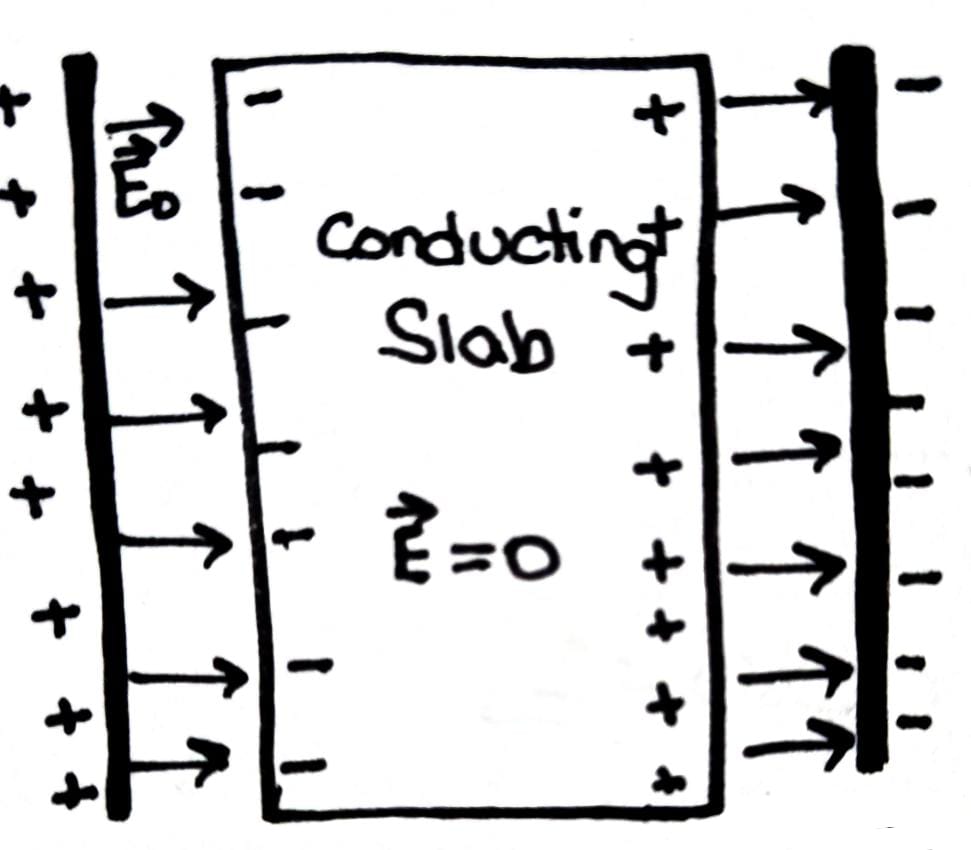
Capacitance of a Parallel Plate Capacitor with a Conducting Slab
Let t be thickness of conducting slab
A be the area of conducting slab
d be the distance between 2 oppositely charged plates
Eo be compatible electrical field that exists over a distance (d – t)
Potential difference between the plates; V = Eo (d-t)

On dividing numerator and denomenator by d , nosotros get

If t = d, i.e., thickness of conducting slab is equivalent to distance between the parallel plates then C = ∞
Dielectrics
Dielectrics are substance which permits charges to exert electrostatic force on 1 another but does not permit period of charges through it. These are essentially insulators which on modest localised deportation of its charges tin can exist easily polarized.
Polar Molecule: When the centre of mass of positive charges or protons tends to coincide with centre of mass of negative charges or electrons, the molecule is said to be a polar molecule. Example: HCl , H2O , NHthree
Non Polar Molecule :When centre of mass of positive charges coincide with centre of mass of negative charges the molecule is said to be non polar molecule. Instance : Northwardii , O2, H2
Polarization
The process of formation of a polar molecule from a not polar molecule by applying external electric field is called polarization. P = εo Χ E
Hither χ is constant of proportionality
Polarization of a non polar dielectric in an external electrical field
- The dipole moment of a non polar molecule in absence of external electric field is naught.
- On applying external electric field, the centre of positive charges are displaced in the direction of external field while the center of negative charges are displaced in the management opposite to that of external field.
- This displacement of charges proceed till the force exerted by external field is balanced past restoring force due to internal field.
- Every bit a effect a not-polar molecule is stretched to a polar molecule which is called equally induced electric dipole.
- This non polar molecule remains as a polar molecule till an electric field is applied beyond information technology.
Polarization of a polar dielectric in an external electric field
- Polar molecules accept permanent dipole moment. The dipole moment of different molecules are randomly arranged in the absenteeism of whatever external electrical field.
- On applying the external electric field the dipole moment of these molecules tends to a lying along the field. Thus a internet dipole moment is induced in the direction of field.
Electric Susceptibility
It is a measure out of extent to which a material gets polarized when placed in an external electric field.

This is the required relation betwixt electric susceptibilty and dielectric constant.
Effect of Dielectric on Various Parameters
Let Qo, Co , Vo, Eo and Uo exist the accuse, capacitance, potential divergence, electric field and energy stored respectively before the insertion of dielectric slab.
| When Bombardment is kept disconnected from the capacitor | When battery remains connected across the capacitor |
| Capacitance increases by Chiliad times; C = 1000 Co | Capacitance increases by K times; C = K Co |
| Charge on the capacitor remains Qo | Potential difference remains constant, i.e., Vo |
| Electrical Potential decreases by Thousand times | Accuse increases by K times Q = CV = One thousand CoV = K Qo |
| Electric field decreases past K times | Electric field remains constant |
| Energy stored decreases by M times | Energy stored increases by K times |


We would love your reading of Electric Charges and Fields, Electrostatic Potential and Capacitance, Magnetism and Matter, Electromagnetic Induction , Moving Charge and Magnetism, Current Electricity for scoring better and having deeper understanding of the chapters.
Do share the post if you liked Electrostatic Potential and Capacitance Class 12. For more than updates, keep logging on BrainyLads
Source: https://brainylads.in/2021/08/16/electrostatic-potential-and-capacitance/
0 Response to "if the charge on an isolated spherical conductor is doubled, what happens to its capacitance?"
Postar um comentário