what are the possible ways to finance an increased dividend payout
What makes banks adjust dividend payouts?
This contribution reviews historical drivers of banking company dividend payouts in the euro area. Economic literature presents 3 main reasons for adjustments to dividend payouts: asymmetric information betwixt shareholders and management, the presence of bureau costs, and regulatory constraints. Using a panel data approach, the article finds bear witness supporting all three hypotheses. Banks lower dividends later facing a decline in profits and capital, but counterfactual simulations show that this adjustment could be small. Regulatory restrictions may therefore be warranted in the event of large expected losses or heavy uncertainty.
1 Introduction
Various elements of the regulatory and prudential framework are in place to constrain dividend payouts past banks. Banks remunerate their shareholders for the risks of holding bank equity through discretionary and variable dividend payouts, commonly set annually past decision of a general meeting of shareholders, acting on a recommendation by the depository financial institution's direction. European regulations provide for automatic restrictions on dividend distributions, the then-called maximum distributable amount, which preserves a bank's uppercase base past retaining profits when a bank falls below a pre-divers level of majuscule. Regulators have also introduced further restrictions, related for example to state-aid rules. The European Systemic Risk Board (ESRB) recommended that banks should not pay dividends in 2020 due to the COVID-nineteen pandemic and likewise to conserve capital letter for loss absorption and maintaining loan supply.
2 Information and methodology
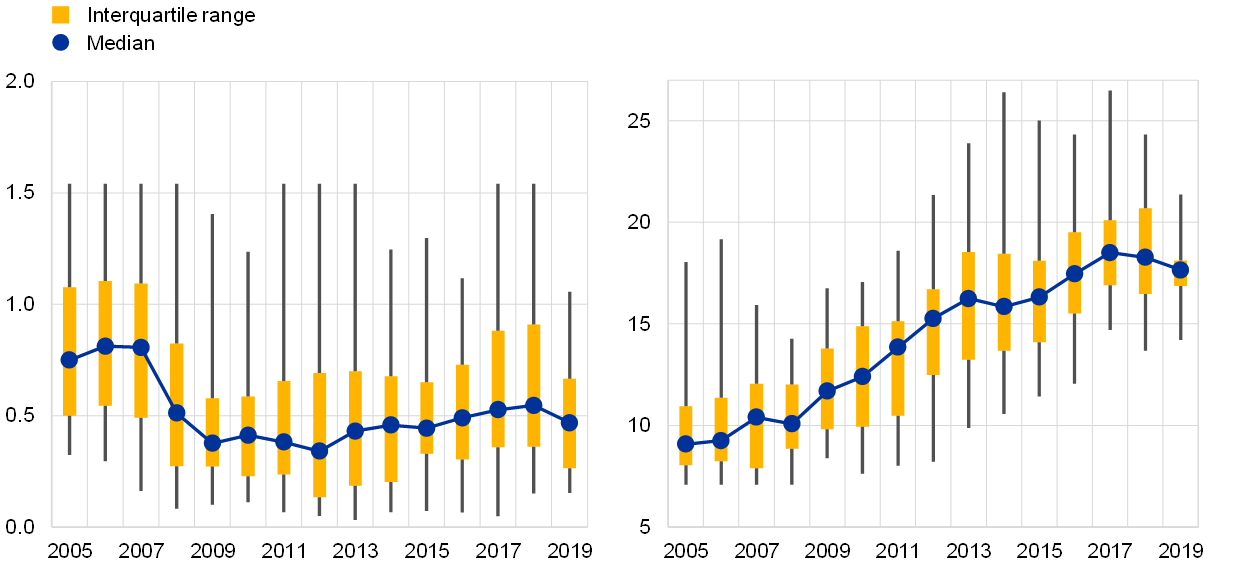
Banking concern dividend payouts accept varied in a seemingly procyclical – albeit heterogeneous – way over the business and financial bike. They reached a high point immediately prior to the global financial crunch and declined in its aftermath (Chart 1) equally regulatory requirements were tightened and banks' profitability fell (Chart 2). However, in that location has been a high cantankerous-sectional variance in every yr for which the information are available, indicating that bank-specific circumstances play a large office in determining payout policies.
Chart 1
Bank dividend payouts fluctuated over time, with big variance across banks
Distribution of dividend payouts by euro expanse banks over time
(y-axis: dividend payout equally a percent of total after-taxation earnings; whiskers: fifth and 95th percentile)

Sources: SNL Fiscal, ECB calculations.
Nautical chart two
Two offsetting factors have played an important role in determining the evolution of dividend payouts
Distribution of return on assets (RoA) (left-hand panel) and capitalisation by euro surface area banks over time
(left - y-centrality: RoA; correct - y-centrality: capital over RWA; whiskers: fifth and 95th percentile)
Sources: SNL Fiscal, ECB calculations.
Economical literature suggests that dividend policies might vary due to asymmetric information, bureau costs, and regulation. While the Modigliani-Miller theorem would propose that, with perfect information and in the absence of revenue enhancement distortions, dividend policies are irrelevant to the value of the firm, its assumptions may not be a fit to the specific aspects of banks. In particular, in that location are three main strands of literature analysing dividend policies which utilize nicely to banks.[i] First, according to the signalling theory, managers may know more than virtually the true value of their business firm than investors. Dividend announcements convey information about time to come earnings, and then more profitable banks may be expected to pay college dividends.[2] Second, the incomplete contract strand suggests that bureau costs, associated with a conflict between stockholders, management, and bondholders over dividend policy would lead larger firms to pay college dividends,[3] while better investor protection allows investors to reduce agency costs by effectively forcing management to pay out dividends. Finally, the regulatory strand suggests that banks are constrained by regulators in their dividend payout policy, implying that better capitalised banks pay higher dividends.[4]
This commodity explores these hypotheses in an empirical context of the euro surface area banking sector, using panel data approaches. We use ii complementary unbalanced panels of euro area banks. The sample of listed banks covers 69 cyberbanking groups observed over 2005-2019, with data collected from SNL Fiscal. The second panel covers most 1,400 banks, a big majority of which are unlisted, over a shorter period (2010-2019) and the data was collected from Orbis BankFocus. We adopted a Tobit specification to account for the fact that bank dividend payouts are truncated at zero, and also used a standard panel arroyo as a robustness check.[5] In social club to limit the effect of outliers, and in particular to exclude banks that may exist subject to non-disclosed supervisory restrictions on distributions,[half dozen] banks with negative after-revenue enhancement earnings and majuscule ratios were excluded.
We aimed to identify the banking concern-specific characteristics that explain the changes in the bank dividend payout ratio. The dependent variable was divers as a ratio of total dividend payout over total after-tax earnings. Leveraging on the existing literature encompassing the key variables explaining dividend payout, variants of the post-obit equation were estimated in the first stage:
where DP denotes dividend payout in bank i at fourth dimension t, which is explained by signalling hypothesis variables (SHV), bureau hypothesis variables (AHV), regulatory hypothesis variables (RHV), and other variables (OV).
In line with the literature, we used indicators of profitability to validate the signalling hypothesis, and bank size to validate the agency cost hypothesis. We besides used a minority shareholder protection indicator, obtained from the Globe Depository financial institution's Doing Business surveys, equally a measure of investor protection that might provide additional evidence for the agency cost hypothesis. Capital ratios were used to seek evidence for the regulatory cost hypothesis.[7] For robustness purposes, nosotros employed both a risk-weighted majuscule ratio (equity over risk-weighted assets) and a rest-sheet-leverage ratio (equity over full assets) equally indicators of capitalisation, and two indicators of profitability (return on assets and return on disinterestedness). Finally, we used GDP growth and time-fixed effects to control for changes in the macroeconomic and fiscal environment. All dependent variables were lagged by one twelvemonth to mitigate potential endogeneity associated with simultaneity and to business relationship for the fact that bank dividend payouts are adamant by shareholder meetings early in the fiscal year, based on financial information available for the previous year.
iii Results
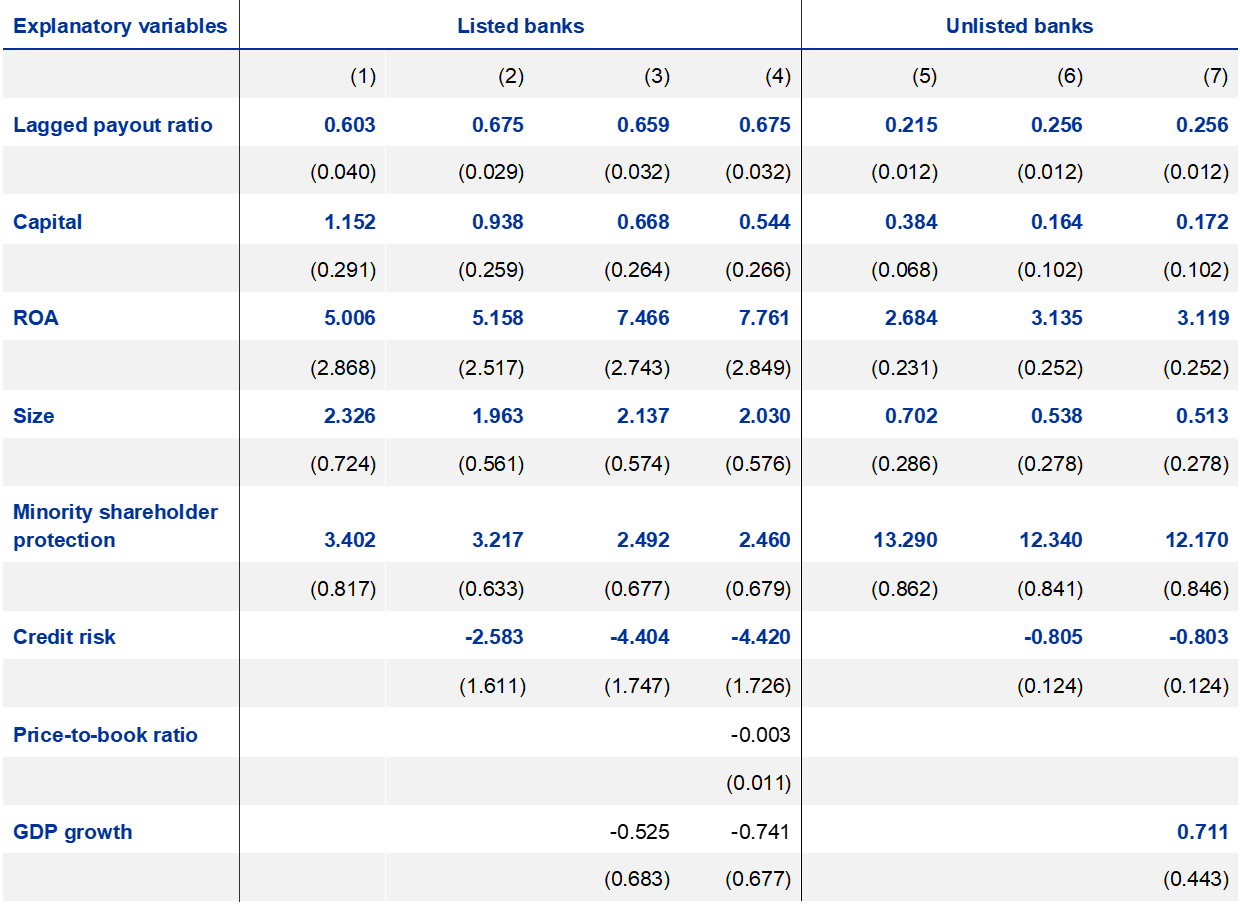
Empirical results suggest that bank dividend payouts are related to capitalisation, profitability, size and institutional framework, supporting all three hypotheses presented in the literature (meet Table ane). In line with the regulatory hypothesis, meliorate capitalised banks tend to pay out a larger share of their profits to shareholders, although the immediate effect of an increase in the capital ratio was estimated to be relatively moderate. An increment in the capital ratio by ane pct point translates into the payout ratio increasing by betwixt less than 0.ii and almost one percent points, with a stronger event for listed banks. Similarly, the results are aligned with the signalling hypothesis, every bit more profitable banks tend to pay out higher dividends, once more with a stronger relationship identified for listed banks. The posited influence of agency costs on payout ratio is also supported by the findings, as banks operating in countries where investors are better protected by law and larger banks tend to pay college dividends. The sensitivity of payouts to the level of institutional protections is stronger for unlisted banks, tentatively pointing to a beneficial upshot of the transparency associated with listed banks on agency costs. Furthermore, higher credit risk is associated with smaller pay-outs, which may advise that banks retain earnings to shore up their residue sheets against future credit losses. Finally, dividend policies seem relatively stable over time, particularly for listed banks. However, there is no significant human relationship between the economic cycle and dividend policies.[8]
Table i
Banking concern-specific variables explicate the variation in dividend payouts
Sources: ECB calculations based on Orbis BankFocus, SNL Financial, and World Bank data.
Note: All regressions include fourth dimension-fixed effects and apply a Tobit specification. Bold denotes coefficients significant at a x% level. Standard errors reported in brackets. A toll-to-book ratio is included in the regressions just for listed banks. ROA proxies asymmetric information (SHV), shareholder protection and size (expressed as a log of assets) proxy agency cost (AHV), capital (expressed as regulatory capital over RWA) proxies regulatory constraints (RHV), toll-to-book ratio proxies forward-looking variables while remaining variables capture remaining effects.
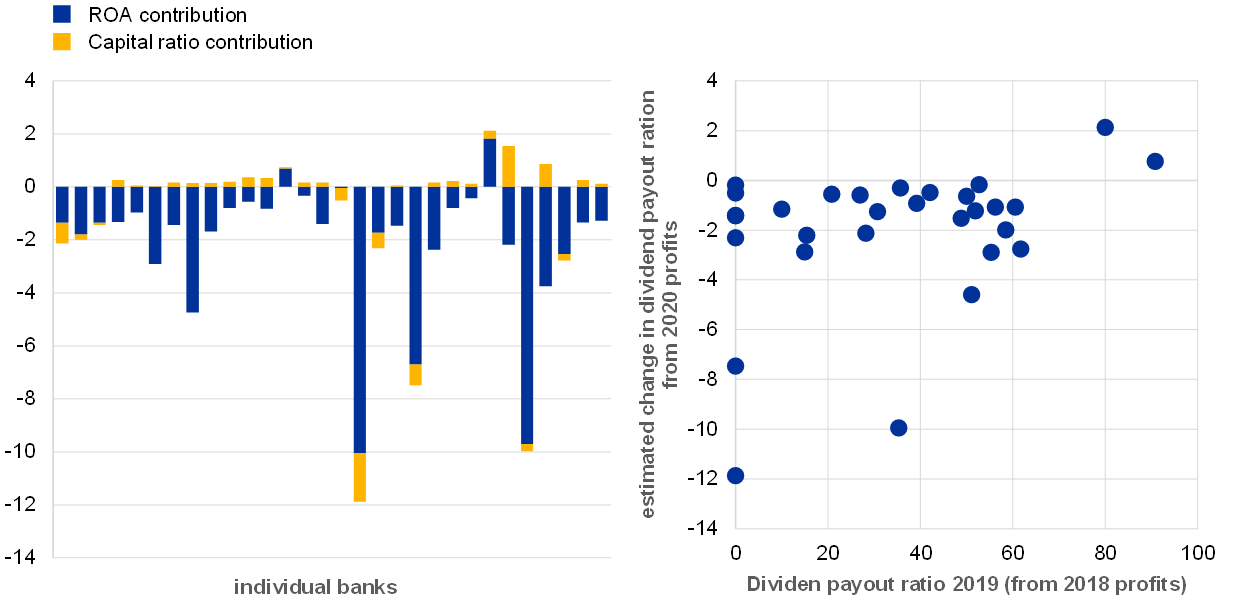
A simulation exercise shows that, in absence of the 2020 recommendation to withhold paying dividends, a significant part of bank profits would have been paid out to shareholders. Using the econometric specifications (1) to (half-dozen) and actual realisations of majuscule and profitability upward to the third quarter of 2020, we estimated the counterfactual payout ratios for the sample of 30 listed euro area banks. The results suggested that payout ratios would be adjusted downward by most banks, although the aligning would be small (up to 4 percentage points for most banks), reflecting the turn down in profits and a broadly steady level of capital. Some of the banks projected to decrease payouts did not pay any dividends in 2020 (Nautical chart three). Together with a projected moderate increment in payouts by 2 banks, this would lead to an nigh unchanged full value of distributions, of nearly EUR nineteen billion, for this group of banks. This simulation comes with a caveat that, as the COVID-19 crunch led to economic disruptions that were unprecedented in Europe in peacetime, the relationships identified from the data may no longer hold true. Its results should therefore exist viewed with some caution as the magnitude of the reduction in dividends would and then, in all likelihood, exist understated.
Nautical chart iii
Simulation results suggest payouts would accept been slightly lower in 2020 than in 2019
Estimated changes in bank dividend payouts in 2020
(left- y-centrality: estimated change in payout ratios in 2020, percent points; right - x-axis: payout ratio in 2019, y-axis: estimated alter in payout ratio in 2020)
Sources: ECB supervisory data, ECB calculations.
4 Policy implications
These results indicate that dividend restrictions may exist necessary to retain capital in times of heightened economic uncertainty. Absent prudential constraints, endogenous adjustment of dividend policies by banks based on economic and financial driving factors would be expected to reflect weaker profitability and capitalization. The adjustment would be limited in magnitude and might come up with a lag. Therefore, regulators may need to impose restrictions on dividend payouts with a more than forward-looking view than that of the banks, especially in presence of great uncertainty about the financial impact of a developing crisis. The findings imply that information technology would be justified to discount futurity expected losses and capital constraints when designing such restrictions.
References
Abreu, J. F. and Gulamhussen, M. A. (2013), "Dividend payouts: evidence from U.South. bank holding companies in the context of the financial crisis", Journal of Corporate Finance, Vol. 22, pp. 54-65.
Allen, F., and Michaely, R. (2003), "Payout policy", in Constantinides, M.1000., Harris, Yard. and Stulz, R.M. (eds.), Handbook of the Economics of Finance, vol. ane, Part 1, ch. 07, Elsevier, pp. 337-429.
Amore, K.D. and Murtinu, Southward. (2019), "Tobit models in strategy enquiry: Critical issues and applications", Global Strategy Journal, pp. 1-25.
Ashraf, B.Northward, Bibi, B. and Zheng, C. (2016), "How to regulate banking company dividends? Is capital regulation an respond?", Economic Modelling, Vol. 57, pp. 281-293.
Belloni, M., Grodzicki, Thou. and Jarmuzek, M. (2021), "What makes banks accommodate dividend pay-outs", mimeo.
Boldin, R. and Leggett, K. (1995), "Bank dividend policy every bit a signal of depository financial institution quality", Financial Services Review, Vol. 4, pp. one-8.
Casey, K.Chiliad. and Dickens, R. (2000), "The furnishings of tax and regulatory changes on commercial bank dividend policy", Quarterly Review of Economics and Finance, Vol. 40, pp. 279-293.
Fama, E. and Babiak, H. (1968), "Dividend Policy: an Empirical Analysis", Journal of the American Statistical Clan, Vol. 63, pp. 1132-1161.
Fama, E. and French, K. (2001), "Disappearing dividends: changing firm characteristics or lower propensity to pay?", Periodical of Fiscal Economics, Vol. 60, pp. 3-43.
Forti, C. and Schiozer, R. (2015), "Bank dividends and signalling to information-sensitive depositors", Periodical of Banking and Finance, Vol. 56, pp. one-11.
Kent Baker, H. and De Ridder, A. (2018), "Payout policy in industrial and financial firms", Global Finance Journal, Vol. 37, Issue C, pp. 138-151.
Kroszner, R. and Strahan, P. (1996), "Regulatory incentives and the thrift crunch: dividends, mutual-to-stock conversions, and financial distress", Periodical of Finance, Vol. 51, pp. 1285-1319.
Lintner, J. (1956), "Distribution of incomes of corporations among dividends, retained earnings and taxes", American Economical Review, Vol. 46, pp. 97-113.
Theis, J. and Dutta, A. (2009), "Explanatory factors of banking concern dividend policy: revisited", Managerial Finance, Vol. 35, pp. 501-508.
Source: https://www.ecb.europa.eu/pub/financial-stability/macroprudential-bulletin/html/ecb.mpbu202106_4~63bf1035a7.en.html
0 Response to "what are the possible ways to finance an increased dividend payout"
Postar um comentário